 Get in touch
Get in touch
Get in touch
umesq builds wireless mesh networks that connect battery-powered sensors and actuators wherever a cable or cellular signal can't reach — inside buildings, across farms and cities, and deep into industrial sites. Every node relays for its neighbors, so the network grows, heals and keeps running with no wiring and no site survey.
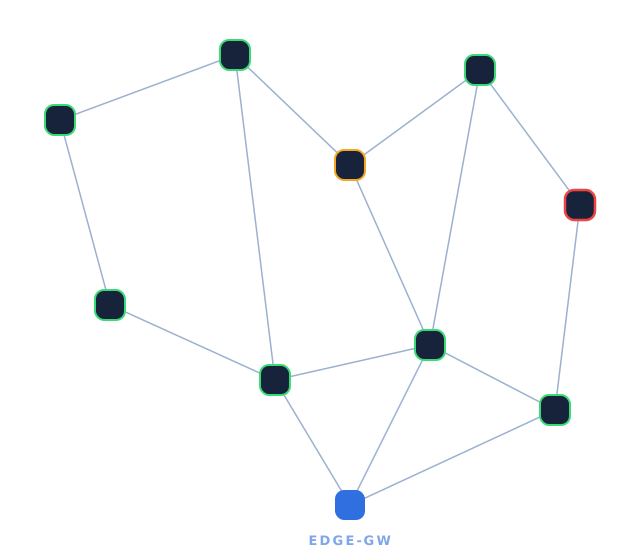
The umesq mesh protocol is built to disappear into the background of a deployment. It scales from a handful of nodes to thousands on the same stack, runs for years on standard batteries, and gives developers a small, well-documented API instead of a proprietary black box — so a network that took months to plan with cable can go in over an afternoon.
Nodes find each other and join automatically — start with ten sensors and scale to thousands without redesigning the network.
Every node, including relays, can run on standard batteries for years at a time — with no mains-powered routers to install or maintain.
Start with umesq modules, choose partner hardware that's already integrated, or license the protocol stack for your own silicon — the mesh behaves the same either way.
License the umesq mesh stack for your own choice of SoC, radio and PCB — with customized releases for teams building at volume.
Learn more →Choose from sensors, gateways and boards that partners have integrated with the umesq mesh.
Learn more →Modules, evaluation kits and development boards for getting a working mesh on the bench.
Learn more →One module family, three radio options — 2.4 GHz ISM, 868 MHz and 915 MHz for long-range sub-GHz coverage.
How self-healing routing and redundant paths let a wireless mesh match the uptime of a wired network, even as individual nodes fail or move.
A field-level look at what actually drains a sensor node's battery, and how duty-cycled radio scheduling stretches standard cells further.
When to trade node density for radio range — combining multi-hop mesh routing with a long-range physical layer for sparse, wide-area deployments.
We started umesq because too many good sensor deployments were getting cancelled over a cabling budget, not a technology limit. Purpose-built battery-powered mesh networking removes that constraint: instead of engineering around where power and cable already exist, you place sensors where the data actually is and let the mesh find its own way back. That's the problem umesq exists to solve — and it's why the protocol, the modules and the licensing model are all built around a network that installs itself.
About umesq →
Fill in your details and we’ll e-mail you “”.